Thursday, January 28, 2016

ETRI presents a blueprint of the 5G Future

We will see a huge change in the way we access the the internet in the future when 5G is here, at speeds that only big businesses and high level internet companies see at the moment, we will have this to hand on our smart phones and tablets. When 5G is hundreds of times faster than any of the UK's broadbands, households will be looking to the mobile phone companies to supply their home broadband.

A 5G future is no longer a distant one, but an upcoming reality. High quality videos of more than 10Mbps can be served simultaneously to 100 users even in a train running at up to 500km/h. People can experience data rates that are 100 times faster than currently available technologies.

The Electronics and Telecommunications Research Institute (ETRI) of Korea will hold a "5G technology demonstration" on the 18th December, 2015. It will demonstrate future SNS (social network service) and several 5G core technologies such as "millimeter wave", "Mobile Hot-spot Network", "in-band full duplex" and so on.

5G is the next generation wireless technology that would provide even faster data rates, even lower delays, and even more devices connected than 4G. Accordingly, distinct and differentiated applications are expected in 5G.

ETRI's "future SNS" is a kind of trial service model to apply 5G technologies that provides dynamic user-centric connection to neighboring people, things and spaces. It is characterized by instant content-sharing between users, communication with neighboring things, and Giga-bps(Gbps)-grade video applications in vehicles.

5G core technologies demonstrated by ETRI include the following:

-- MHN (Mobile Hot-spot Network) is a mobile backhaul technology that provides high-speed Internet access of Gbps in vehicles at speeds of up to 500 km/h (e.g. KTX in Korea). Almost 100 passengers can watch videos of high quality simultaneously.

-- ZING is a near-field communication technology that enables mass data to be transmitted with 3.5 Gbps data rate between neighboring devices within the radius of 10cm.

-- Single-RF-Chain compact MIMO technology enables a single antenna to simulate the effect of multiple antenna. It can reduce antenna volume and cancel inter-antenna interference in a multi-antenna system.

-- Millimeter wave (mmWave) beam switching technology provides fast switching of radio beams to mobile users, and therefore allows seamless Gbps-grade service in mobile environments.

-- Mobile Edge Platform (MEP) is a mobile edge cloud server on vehicles that enables passengers to enjoy customized Gbps-grade content and connects them with neighbors, things and spaces. It provides user-centric services.

-- In-band Full Duplex technology can transmit and receive signals simultaneously over the same frequency band. It can increase spectral efficiency by up to two times.

-- Small cell SW technology is designed for AP(Access Point)-sized small cell base stations that can reduce communication dead zones and improve data rates per user in a hot-spot area.

"With this demonstration event, we are officially introducing our R&D results on 5G. We will continue to lead the development of 5G technologies. Also, we are trying to develop commercialization technologies needed by businesses, and to construct a 5G ecosystem." said Dr. Hyun Kyu Chung, vice president of ETRI Communication & Internet Lab.


In January, 2016, ETRI will demonstrate Giga internet service and future SNS in a Seoul subway train installed with MHN and ZING kiosks. ETRI will also introduce hand-over technology on a millimeter wave mobile communication system and 5G radio access technology that satisfies 1 millisecond radio latency.

About ETRI

Established in 1976, ETRI is a non-profit Korean government-funded research organization that has been at the forefront of technological excellence for about 40 years. In the 1980s, ETRI developed TDX (Time Division Exchange) and 4M DRAM. In the 1990s, ETRI commercialized CDMA (Code Division Multiple Access) for the first time in the world. In the 2000s, ETRI developed Terrestrial DMB, WiBro, and LTE-A, which became the foundation of mobile communications.

Recently, as a global ICT leader, ETRI has been advancing communication and convergence by developing Ship Area Network technology, Genie Talk (world class portable automatic interpretation; Korean-English/Japanese/Chinese), and automated valet parking technology. As of 2015, ETRI has about 2,000 employees where about 1,800 of them are researchers.

Sunday, January 17, 2016

Ice Age Lion Cubs found Perfectly Preserved in Siberia

Cancer affects millions of lives, possibly even more. Everybody knows somebody that has been forever hurt, either physically or emotionally, by this vicious, unforgiving ailment. Most of us know somebody who has lost their life to the disease.

Despite this, cancer survival rates are higher than ever before. In recent years, cancer treatment has improved rapidly, but a complete cure has always appeared to be just beyond reach, a tantalising Holy Grail of medical science. This month, however, an announcement was made that could have the potential to end all that.

The good news is that human trials could begin in as little as four years’ time. If those trials prove to be successful, then science will have made a major stride towards eradicating the disease completely.

A joint Dutch/Canadian team stumbled across this miraculous discovery whilst searching for ways to treat malaria in pregnant women.


According to the team, the carbohydrate that malaria attacks in the placenta is exactly the same as a carbohydrate present in cancer cells.

As Metro.co.uk reports, Ali Salanti from the University of Copenhagen said, “for decades, scientists have been searching for similarities between the growth of a placenta and a tumor (...) The placenta is an organ, which within a few months grows from only few cells into an organ weighing approx. two pounds, and it provides the embryo with oxygen and nourishment in a relatively foreign environment. (...) In a manner of speaking, tumors do much the same, they grow aggressively in a relatively foreign environment.”

Intrigued by this idea, the team tailored a special malaria protein to include a toxin designed to target cancerous cells. The cancer cells absorb the protein and are then in turn killed by the malaria virus. Theoretically, this idea is sound and experiments on mice with cancer have already begun.

It’s definitely early days yet, but the team are hopeful that this innovative new treatment could provide scientists with a valuable weapon in the fight against cancer. If the trials are successful, the potential benefits are simply staggering to consider. It just goes to show that no dream is too big to accomplish, provided we never stop believing that it’s possible. Imagine a world without cancer and perhaps, in time, we won’t have to.

Monday, December 21, 2015

Alonso unfazed by rule changes

Fernando Alonso doesn't believe the changes to the start procedures that will come into effect at Spa will make much of a difference.

As of this weekend's Belgium Grand Prix, the FIA will clamp down on radio communication between drivers and the pitwall and only critical information will be relayed. Teams will also be prevented from changing the clutch bite point once the cars leave the garage ahead of the race.

However, two-time World Champion Alonso isn't expecting any disruption to his usual pre-race strategy.

"It will not be a significant change. I know that there is some talk about this but maybe for next year or the following years will be more different," the Spaniard said.

"What we will have here is just some restrictions in communications with the drivers and the team etc but I think... at least in our team we were not doing any specific communication or strategy during the formation laps etc so it will not change much."


There will be more changes next year as the FIA has issued a technical directive that states engineers will not be able to coach the drivers over the radio on things like tyre degradation and fuel saving.

Although the McLaren driver admits drivers will have to "pay a little more attention", he doesn't think it be a train smash.

"Well, I don't think it will make a huge change because... yeah, we are receiving some information now on the radio about tyres, about fuel or other things on the car but we are perfectly aware of what is happening in the car and what is the best solution for the specific issues that we are facing during the race so if that information is not coming, it will come anyway by instinct and by the reactions of the car," he said.

"So yeah, we will have to pay a little bit more attention to a few things that now we rely a little bit on the radio but it's not a big change and probably it's welcome, all those changes, to have a little bit more to do in the car and feeling a little bit more important."

It's difficult to see why F1 are strangling the communications between drivers and teams, One team does not gain anything over any other by relaying information over the radio, but as Alonso has said in this article on planetf1.com it's not an issue.

Friday, December 11, 2015

Workplace adjustments for employees with a hearing impairment

For employees with a hearing impairment, the presence of sound in the workplace can be a daily challenge and a source of frustration. Robin Christopherson looks at how employers can manage potential problems.

Wherever you work, and whatever your role, there is a strong chance that you are routinely bombarded by noise from a variety of different sources. Telephones ringing, printers whirring, music playing on the shop floor or the constant hum of colleagues talking in a open-plan office, the world of work is full of sound.

According to the Health and Safety Executive, around 17,000 employees in the UK experience deafness, ringing in the ears or other ear conditions caused by excessive noise at work.


Action on Hearing Loss estimates that at least 800,000 people in the UK are severely or profoundly deaf, but this is a small proportion of the 10 million people with some form of hearing loss, of which it estimates that 3.7 million are of working age. There are no exact figures on the numbers of people who use British Sign Language (BSL) to communicate, but the estimate is around 50,000.

An employee’s hearing can be impaired in many ways; there is a whole spectrum of

hearing ability and there are lots of different causes of hearing loss, as well as a variety of possible implications in the workplace.

Types of hearing impairment include:


  • age-related;


  • temporary or permanent;


  • progressive; and


  • environmental factors.


Impacts of a hearing impairment


As hearing is not something we can “see”, it can be difficult to determine whether or not a colleague’s hearing is impaired. This can make it difficult for line managers to know who to help, and when.

In meetings, presentations, networking events or interviews, a hearing impairment could have an impact on an employee’s ability to do their job, if they are not properly supported or if the working environment is not inclusive of their needs.

There can also often be an emotional response to hearing loss, which impacts on the social and wellbeing of the employee. If you are unable to hear what colleagues are saying clearly, you might miss out on vital information needed for your role, or you might miss the latest bit of office banter, which makes you feel isolated and excluded, having a negative impact on morale.

Reasonable adjustments


Employees with a hearing impairment are protected under the Equality Act 2010 and employers are required to remove the barriers that deaf and other disabled people experience in the workplace. There are a number of different ways to ensure that an organisation is accommodating the needs of deaf or hearing-impaired employees.

Benefits of technology


We are all using technology in the workplace, without really thinking about it, as part of our day-to-day communications. How much of the information you share with colleagues or clients is via the phone, email, your intranet, website, a PowerPoint presentation or a short video? The answer is, of course, nearly all of it.

Technology can work as an enabler as well as a disabler. A message from your organisation’s CEO via video on your corporate intranet can be a really powerful way to communicate with your workforce, but if that video does not have subtitles or captions, you are excluding a proportion of your staff, not limited to those with a hearing impairment but also people whose first language is not English.

A variety of technologies can be used in the workplace to support employees with a hearing impairment. There are some specialist programs available that are specifically designed to support people with hearing loss, but many of the mainstream programs and equipment that your organisation already uses could also be adapted at little to no cost. They include:


  • text messaging, and email;


  • amplified sound alerts built into PCs;


  • a flashing screen on a mobile device when a sound alert is triggered;


  • bluetooth to connect to hearing aids;


  • captions for videos;


  • BSL on-demand services;


  • video calling for signing or lip-reading;


  • palentypists and stenographers; and


  • voice recognition speech-to-text software.


Sometimes the most effective adjustments are made by simply utilising existing resources in a different way. For example, if important company announcements are often given over a tannoy or PA system, which would be difficult or impossible for someone with a hearing impairment to hear, you could also issue the same message via email or text message.

There are also times when specialist adjustments, such as using a palentypist or BSL interpreter, need to be arranged. It is important that the individual employee gets the adjustment that they require, when they require it â€" because no two people with a hearing impairment are the same.

This article highlights the many advancements that have been made in the field of hearing protection at work, and ten years after the Control of Noise at Work Regulations 2005 came into force we should have completely eradicated high levels of noise or the need to control it into the workplace, the original of this article can be found here.

Sunday, December 6, 2015

A Right Cock-Up: Hilarity Ensues As Council Workers Paint Huge Tarmac Penises For Fun & Profit

A residential area in Tamworth, Staffordshire has become the talk of the Internet after council workers painted a bunch of dicks on the tarmac there.

Staffordshire County Council contractors Amey were tasked with the job of re-painting some old road markings in the area and apparently, they decided to get a little bit creative with the task. Using their school desks and the cubicle walls of gents toilets for artistic inspiration, the team apparently painted a dazzling array of gigantic penises all along the tarmac.

Yahoo! News as saying, “There are some very bizarre, obscene shapes. One of them looks like someones giving someone the finger sign”.

Well, if you can create a detailed hand giving someone the finger using road paint, Id say that youre probably some sort of artistic genius. However, my personal favorite is still the extra long, almost mournful penis that appears to be dragging his two big balls across the street in search of food...Theres just an unspoken poetry to it all if you ask me.

Apparently, the paint settled down long before the local residents did and any surviving penises have since been hunted down and eliminated by the contractors.

All joking aside (but not for long, I promise!), whether the phalluses were painted there deliberately or not, this story really serves to highlight what a humorless bunch of dicks the British public can be at times.

Friday, November 6, 2015

Commonwealth countries adopt action plan towards achieving consensus ahead of WRC15

Commonwealth countries adopt action plan towards achieving consensus ahead of WRC-15 - CTO: Commonwealth Telecommunications Organisation

Commonwealth countries taking part in the group of nations’ preparatory meeting last week in London ahead of the forthcoming 2015 World Radiocommunication Conference (WRC-15) have adopted an action plan towards achieving consensus at the international conference next month.

WRC-15, which will allocate new spectrum for radio communications, including for international mobile telecommunication (IMT) services will take place from 2 to 27 November 2015 in Geneva, Switzerland under the auspices of the International Telecommunication Union (ITU).

All regional groupsâ€"whose positions guide the WRC processâ€"include Commonwealth countries among their members. The London meeting which took place on 7 â€" 9 October 2015 was an opportunity for members of these regional groups to better appreciate the views and positions of other regions and help achieve greater consensus.

Chaired by Anil Kaushal, Member of the Board of the Telecommunications Regulatory Authority of India, the meeting elected a Bureau to coordinate the views of Commonwealth countries during the Conference next month. The Bureau includes Dr Edmund Katiti (Uganda) as the WRC Commonwealth Coordinator; representatives from Canada, India, Malaysia, Papua New Guinea, UK and the Caribbean as Vice-Coordinators; and Edmund Fianko (Ghana) as the WRC Commonwealth Rapporteur. Agenda Item Coordinators were also appointed.

Sharing his satisfaction at the end of the three-day meeting, the CTO’s Secretary-General Shola Taylor said he was satisfied that “this meeting has helped to better understand the various positions by different regions, and has also highlighted areas where clarity was still required, and we are grateful to the ITU for its contributions throughout our discussions”.

Key outcomes of the London meeting include:


  • Strong support for identification of additional spectrum for IMT in most parts of the L band;


  • Resolve to protect digital terrestrial television in the UHF band;


  • Future studies on potential use of part of the S band for IMT;


  • Mechanisms to achieve consensus on the lower part of the C band taking into account the growing demand for mobile broadband and the needs of countries like in the Pacific which depend heavily on satellites;


  • Support for future studies for IMT above 6 GHz to accommodate 5G, excluding Ku and Ka satellite bands;


  • A mechanism for further engagement with various regions on the possible use of FSS for unmanned aircraft, taking into account aviation safety concerns;


  • Support for global harmonisation on Earth Stations on Mobile Platforms; and


  • Recognition of the importance and urgent treatment of global flight tracking taking into account studies in the Director’s report.


“For Commonwealth countries, this meeting gave a clearer sense of the likely outcomes of WRC-15, so we encourage our members to be proactive and contribute to deliberations in Geneva as efficient as possible,” Mr Taylor added.

Mario Maniewicz, Deputy to the Director of the Radiocommunication Bureau at the ITU gave the participants an overview of preparations for WRC-15, and also provided clarifications on WRC proceedings and rules that will guide the Conference.

Festus Daudu, Chair-Designate of WRC-15 who also took part in the London meeting said discussions were “very productive as they enabled countries represented to better understand all regional positions, and I would like to congratulate the CTO for taking this initiative.”

Private-sector operators such as Inmarsat, Avanti Communications Group, and Google, as well as mobile industry association GSMA also took part in the meeting to express interest in specific spectrum bands in pursuit of advancing global connectivity. The case for safeguarding spectrum resources allocated to broadcasting was made by the BBC who gave a tour of its extensive London production facilities to the participants at the meeting.

Representing the Telecommunications Authority of Trinidad and Tobago, Kirk Sookram, Executive Officer for Technical Service and Development also shared his satisfaction at the end of the event: “The meeting has given Caribbean participants a great opportunity to understand within a single forum the views of all other regions that have some of their members in the Commonwealth,” he said.

The initiative of the London pre-WRC-15 meeting by the CTO is part of a wider programme of activities to implement a specific mandate of Commonwealth ICT ministers at their meeting held in London in March 2014 to coordinate all ICT matters in the Commonwealth.

Earlier this week, less than a month after assuming office, Mr Taylor had met with Houlin Zhao, Secretary-General of the ITU in Geneva to discuss wider collaboration between the two organisations.

Wednesday, November 4, 2015

Wrestling Legend Rowdy Roddy Piper Dies At 61

The world of professional wrestling is in mourning following the death of the legendary Rowdy Roddy Piper last month. Piper suffered a cardiac arrest whilst at his home in Hollywood, California. He was just 61 years old.

For many kids (including myself) that first became fans in the mid-late 1980’s, Roddy Piper was the definitive wrestling heel (industry jargon for a bad guy). Whether hosting his notorious Piper’s Pit segment, or facing off against Hulk Hogan & Mr. T (with partner Mr. Wonderful Paul Orndorf) at the inaugural WrestleMania event, Piper was one of the industry’s biggest starts during one of its most popular and lucrative periods.

He was also instrumental in making the WWF (now WWE) brand the biggest in professional wrestling. In addition to headlining the very first WrestleMania event (a pioneering Pay-Per View extravaganza that could easily have ruined the company had it proved to be a failure), Piper also featured in one of WrestleMania II’s three main event matchups, thus securing his position as one of wrestling’s most bankable stars.

His undercard matches at WrestleManias III, VI and (the stone cold classic against Bret The Hitman Hart at) VIII are absolute highlights of a classic era of pro wrestling. He even acted as a guest referee for the main event of Bret Hart vs. Yokozuna at WrestleMania X. Younger fans, however, will undoubtedly remember Piper teaming with fellow veterans Ricky Steamboat and Jimmy Superfly Snuka to face Chris Jericho at WrestleMania XXV.

In an era defined by outlandish babyface characters with bodybuilder physiques and sometimes questionable in-ring abilities, Roddy Piper stood out as a genuine wrestler’s wrestler, an authentic tough guy - and the necessarily evil counterpoint to the simplistic, superheroic good guys being featured at the time by the WWF.

Born in Saskatoon, Saskatchewan, Canada in 1954, Roderick Toombs was always an unruly personality. Expelled from school at a young age and subsequently falling out with his father, (a member of the Royal Canadian Mounted Police) Toombs hit the road, staying in various youth hostels and earning a buck wherever he could. Eventually, the tempestuous youth wound up in a wrestling ring, making his in-ring debut at the tender age of just 15-years-old.

The kid was tough (he had a Black Belt in Judo), displayed a natural affinity for the ring and he had a roguish charisma all of his own. In addition, he really could play the bagpipes. After early stints jobbing in Verne Gagne’s AWA, NWA Houston and Fritz Von Erich’s Big Time Wrestling promotion in Dallas, Texas, Piper debuted for Mike and Gene LeBell’s NWA Hollywood promotion and soon became the outfit’s top heel. A slew of regional Championships followed.
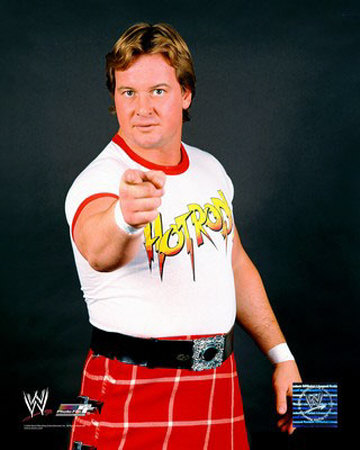


Whilst working for promoter Roy Shire in the NWA’s San Francisco territory, Piper developed his character and ring work. In Los Angeles, he feuded with Chavo Guerrero Sr, Hector Guerrero and ultimately locked up against their father, Mexican wrestling legend Gory Guerrero (father of future WWE Champ Eddie). In The Pacific Northwest, he unseated former NWA World’s Heavyweight Champion Jack Brisco for Mid Atlantic’s version of the World Heavyweight Championship, a title he would go on to hold twice more.

In the mid 1980’s, Piper entered Vince McMahon’s insurgent WWF. He was billed as being from Glasgow, Scotland and was well known for being the only wrestler to wear a kilt to the ring. Fans ate it up. Feuding with such stars as Hulk Hogan, Adrian Adonis, Andre The Giant, Jimmy Superfly Snuka, Million Dollar Man Ted DiBiase, Jerry The King Lawler and Bret Hitman Hart, to name but a few, Piper always brought out the best in his opponents and it was with the WWF that he became a household name, as well as one of the industry’s biggest ever stars.

In the mid-1990’s, Piper wrestled for WCW (World Championship Wrestling), where he debuted as one of the company’s headline stars. He feuded, once again, with Hulk Hogan and also battled old rivals such as Ric Flair, Bret Hart and ‘Macho Man’ Randy Savage. Whilst working for WCW, he was even chosen to headline ‘Starrcade’, the company’s flagship Pay-Per-View event.

In his later career, Piper made sporadic reappearances for the WWE, briefly worked for TNA, enjoyed a reasonably successful acting career and also hosted his own podcast. He battled Hodgkin’s Lymphoma after being diagnosed with the illness in 2006, but had completely beaten it into remission as of last year. Despite the setbacks caused by his ill health, Piper wrestled his last match in 2011.

Although he never held a recognised World Heavyweight Championship, Piper will be remembered as one of the greatest WWF Intercontinental Champions of all time, a reign that was attested to during his appearance at this year’s WrestleMania XXXI, where he congratulated then-IC Champion Daniel Bryan on his victory. He also held other notable belts, such as the United States Championship, the WWF/E Tag Team Championship (with Ric Flair) and the NWA World Light Heavyweight Championship.

Piper was a member of the WWE Hall of Fame and the Wrestling Observer Hall of Fame, as well as the Professional Wrestling Hall of Fame. He was also a member of the Cauliflower Alley Club.

On the August 3rd edition of RAW, the entire WWE roster, each member clad in Roddy’s signature Hot Rod t-shirts opened the show with a very moving ten bell salute in tribute to the fallen legend.

WWE boss Vince McMahon said, "Roddy Piper was one of the most entertaining, controversial and bombastic performers ever in WWE, beloved by millions of fans around the world. I extend my deepest condolences to his family."

UFC Bantamweight Champion Rowdy Ronda Rousey dedicated her 34-second victory over Bethe Correia to Piper’s memory, "I just want to say that we lost a really close friend, Rowdy Roddy Piper, who gave me permission to use his name as a fighter (...) And so I hope him and my dad had a good time watching this today."

Former WWE and WCW Champion (and Piper’s frequent in-ring rival) Bret Hart wrote, “I can’t find the words to describe the sorrow in my heart upon learning the news of my dear friend, Roddy Piper, passing away. He was my closest friend in the business, a man that schooled me and guided me throughout my career. In fact, if it wasn’t for Roddy Piper reaching out to help me, I’m sure I would’ve been a mere footnote in wrestling. He was always there for me. He was family to me.” Hart also recalled that, following his stroke in 2002; Piper was the only wrestler who visited him in hospital.

Hulk Hogan, another of Piper’s famous adversaries, said of Piper that, “He was my best friend. He is a legend. God’s gain is our loss. May his family in this time of need, find peace"

Other friends, colleagues and admirers of Piper’s included former WWF Champ The Iron Sheik, who said “Roddy Piper. I love you forever. God bless you Bubba” and multi-time World Champion Chris Jericho Tweeted, “Sorry to hear of the passing of my friend and Wrestlemania rival #RoddyPiper. One of the greatest who ever lived, but more importantly a legit sweet family man with a good heart”. Former WWE Divas Champion Paige called Piper a “legend” and Tweeted a picture of a broken heart, an image which reflected the feelings of many a wrestler and wrestling fan.

Roddy’s son, Colt, said that his father was his “best friend” and a “great man” saying that he would miss him forever and “always try to be the man he raised me to be”.

Rowdy Roddy Piper lived a life littered with accomplishments. Not many of us will ever be declared as legendary by our peers and fewer still will be able to stack 30+ Championship reigns anywhere on our resume, but those weren’t the man’s proudest achievements. Piper had been married to his wife, Kitty, since 1982 and is survived by her and the four children they lovingly raised together. My thoughts are with them, as well as everyone else who knew, worked with, or simply enjoyed to watch the late, great man work his magic in front of a capacity crowd. R.I.P Roddy.